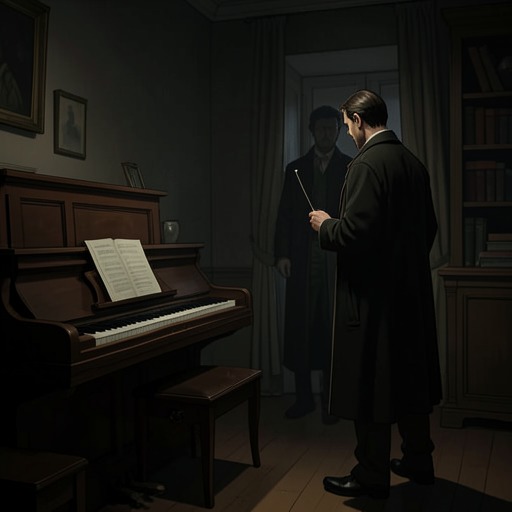
The piano tuner reconnects with his sister
Blind Willow, Sleeping WomanThe piano tuner reconnects with his sister after about ten years without speaking, turning an unexpected decision to call into a long-delayed reconciliation. Their reunion brings old grievances into the open, but it also gives each sibling a chance to acknowledge the other’s pain and renew a relationship neither had stopped hoping to restore.
The call after a long silence
The Tuesday before the call, the piano tuner went to a café where a woman he had been seeing did not appear. He read until one and left. That day he skipped the gym, went straight home, and listened to Arthur Rubinstein playing Chopin ballads. As he pictured the woman and her blue Peugeot, her face gradually faded from his mind; the small mole on her earlobe remained. The remembered detail stayed with him as he lay on the couch, an ordinary image that would later become part of the chain of coincidences prompting him to think of his sister.
At about two thirty, he decided to phone her. They had been estranged for roughly ten years, after a dispute connected with her broken engagement in which both had said things they regretted. His dislike of her husband had deepened the distance: he found the man arrogant and crude, and resented his treatment of the tuner’s homosexuality as though it were contagious. The accumulated resentment made the call difficult. He hesitated several times before dialing and, after more than ten rings, was almost relieved to think she might not answer.
His sister did answer. When she recognized his voice, a deep silence fell between them. She asked flatly why he was calling. He could offer no elaborate explanation: he said he had been worried and wanted to check that she was all right. After another pause, she asked him to wait while she composed herself. He could tell she had been weeping. Then she asked whether she could come to see him, and he agreed to meet her at the station.
Seeing one another again
An hour later, he picked her up and drove her to his apartment. Neither had seen the other in ten years, and the encounter made their aging visible to them as if each were a mirror for the other. She remained slim and stylish, but her cheeks looked hollow and her dark eyes had lost their usual luster. He still appeared younger than his years, though his thinning hair was harder to conceal. Their first conversation stayed with familiar, manageable subjects: work, her children, mutual friends, and their parents’ health.
At the apartment, her question about whether he still played piano opened onto a deeper account of the life changes that had once separated them. He explained that giving up the ambition to be a pianist and coming out as homosexual had helped him return to who he felt he really was. He knew those choices had upset people, but described them as necessary to understanding himself. His sister replied that she should have tried harder to understand him, while also wishing he had explained what was happening before taking those steps.
The disagreement beneath their careful reunion was not simply about what had happened, but about how love should have been made legible. He had wanted his family—especially his sister—to understand him without requiring him to explain himself. Looking back, he admitted that at the time he had been unable to consider other people’s feelings. His life had changed too quickly for him to feel steady: he had been frightened, unable to put his experience into words, and afraid of slipping out of the world. What he had wanted was for his sister to understand and hold him, without argument or explanation.
As he spoke, his voice shook. His sister covered her face and wept silently. He laid a hand on her shoulder; she apologized, and he told her that she need not cry and that he, too, had been at fault. The exchange did not erase the history between them. Instead, it gave both siblings room to name their part in it, with apology and touch doing what their earlier silence had failed to do.
The illness revealed
After they had begun to reconcile, his sister told him she was going into the hospital the next day. She was to have an operation for breast cancer, with her right breast to be removed; at that point, the doctors could not yet know whether the cancer had spread. The news momentarily unsettled the tuner’s sense of the familiar room. He looked from the clock to an ornament, a calendar, and the stereo remote, but could not grasp the distance between the objects.
His sister explained that she had considered getting in touch for a long time and had ultimately decided against it. She had wanted to see him and apologize, but did not want their meeting to happen under such difficult circumstances. She had imagined that, if they met, she could be more optimistic. Just after she made up her mind not to contact him, he called. She was glad that the call had happened, even if she could not explain why its timing felt so significant.
He answered her disclosure without words, drawing her close while they sat together. The embrace followed their attempt to speak through old hurts and the sudden knowledge of the operation ahead. When she asked what had made him think of her, he could only describe a series of coincidences; the sense of distance in the room remained strange to him, and he could not offer a complete explanation. His sister accepted that uncertainty. He then touched and kissed the mole on her right earlobe, connecting the strikingly small detail that had stayed in his mind after the café woman’s absence with the reunion now unfolding before him.
Recovery and renewed family ties
The operation removed his sister’s right breast, but the cancer had not spread. Mild chemotherapy was enough, and her hair did not fall out. The tuner visited her in the hospital almost every day. After she returned home, he continued to visit the family frequently, and the renewed contact widened beyond the siblings: he grew close to his nephew and niece and began teaching his niece piano, whose promise he took pride in.
His view of his brother-in-law also changed with familiarity. He still considered the man self-important and somewhat crude, but came to see that he worked hard and treated his sister well. The brother-in-law, in turn, eventually understood that the tuner’s homosexuality was not something contagious that he would pass to the children. The tuner regarded that shift as small but meaningful. Reconciliation thus changed not only the siblings’ relationship but also the terms on which the wider family could remain together.
The tuner said that getting back together with his sister made him feel he had moved forward and could live more as he was meant to. He believed he had always hoped they would make peace and embrace once more, even if he had been unable to act on that hope for years. His account presents the reconciliation as something he had to face rather than something that could be achieved through explanation alone: the call opened a way back, but the siblings’ frankness, apology, and renewed presence made that possibility lasting.
Coincidence and recognition
When asked whether something had to happen before he could reconcile with his sister, the tuner agreed. He wondered whether coincidences might be common all around people, yet usually go unnoticed. He compared them to fireworks in daylight: a sound might be heard, but the display itself remains invisible. When someone is hoping for a particular outcome, however, a coincidence can become perceptible, like a message rising to the surface.
That reflection gives the reunion its distinctive shape. The remembered mole, the day spent thinking, and the call arriving just after his sister had decided not to make contact do not provide a provable explanation for their estrangement or its repair. The tuner himself cannot say exactly why he called. Their significance lies instead in becoming visible to the siblings at the moment each was ready to recognize what the other meant. The reconciliation turns chance from a puzzle to be solved into an opening: not a replacement for apology or action, but the circumstance through which two people who had hoped to meet again could do so.